01
Guests Don’t Know Local Risk
Many visitors are unfamiliar with the property’s severe storm history or evacuation routes.
Solutions · RV Parks & Resorts
The same Alliance, engineered for open-air properties where guests may not know the local severe weather and flood risk — built for Texas’s first-in-the-nation requirement, and for best practice everywhere else.

RV parks and campgrounds face a version of the camp-safety challenge with its own twist: many guests are visiting from out of state, may not know the property’s severe weather and flood history, and often have no idea a nearby creek or river can rise in minutes. Texas became the first state in the nation to apply a comprehensive weather-warning standard to commercial RV parks and campgrounds — and the rest of the country is watching closely.
The Challenge
01
Many visitors are unfamiliar with the property’s severe storm history or evacuation routes.
02
Sites can stretch across dozens of acres, with guests in RVs, tents, and cabins simultaneously.
03
Watch / Warning / Advisory language confuses the public; alerts must be plain and immediately actionable.
04
The storm that threatens your guests is often the same storm that takes down utility power and cell towers.
Where the Law Stands
Texas became the first state in the nation to apply the NFPA 1194 standard statewide to RV parks and campgrounds, enacted through Senate Bill 1 (the “Heaven’s 27 Camp Safety Act”), with compliance required now and implementation timelines extending into 2026. Under the law, RV parks and private campgrounds — not just youth camps — must maintain a site-level emergency warning system with public-address capability that works without an internet connection, operable radios providing real-time National Weather Service alerts, and continuous monitoring of NWS, local river-authority, and local emergency notifications, with redundant communication paths.
Separately, Senate Bill 3 established a statewide outdoor-warning-siren mandate for flood-prone river-watershed areas — explicitly including RV parks and recreational areas — administered by the Texas Water Development Board, with a roughly $50 million grant program to help fund installation.
Where the Law Is Headed
Coming next
Most current state legislative activity has focused on youth camps first (see our Youth & Summer Camps page for Oklahoma, Alabama, North Carolina, Missouri, and Pennsylvania) — but Texas’s RV park standard is widely seen in the industry as the template other states are likely to extend to commercial campgrounds next. RV park and campground operators in every state should expect this to reach them; the camps have simply been first. We track new state activity quarterly and will update this page as it develops.
Best Practices
01
Indoor phone, text, and email notification, plus outdoor sirens and giant-voice coverage that reach every site, cabin, and common area the moment a threat is confirmed.
02
Continuous, professional-grade monitoring, not a front-desk employee checking a weather app between check-ins.
03
On-site sensors that provide lead time before floodwaters reach the property, especially critical for sites along creeks and rivers.
04
The storm that threatens your guests is often the same storm that takes down the network.
05
Documented, engineered coverage and activation logs, ready for an inspector, an insurer, or your own guests to see.
How We Deliver
No warning system that works without internet
American Signal Corporation and LAWS Systems outdoor siren and PA hardware deliver on-site alerting and public address that operates independently of internet connectivity, activated through WeatherCall’s dashboard and automation.
No real-time NWS monitoring path
WeatherCall’s alerting draws on live National Weather Service data, giving parks continuous, professional-grade severe weather monitoring rather than a single consumer weather app or radio. It’s geofenced to your specific property, not the entire county.
Single point of failure in notification
The Alliance combines siren, PA, phone, text, and email into one coordinated system — the multi-path redundancy inspectors and auditors look for.
No audit-ready compliance record
Timestamped, exportable activation and alert records give operators defensible proof the system was tested and worked — for annual certification, insurance, or after an incident.
Early flood detection along creeks and rivers
Cerebral Robotics’ Wireless Watchman connects water-level sensors directly to your alert pathways, and the Alliance’s hydrology referral network can model exactly how and where water will reach the property.
What We Monitor and Alert For
Every alert traces back to an official National Weather Service warning for your property’s exact location — not a generic county-wide notice.
Meet the Alliance
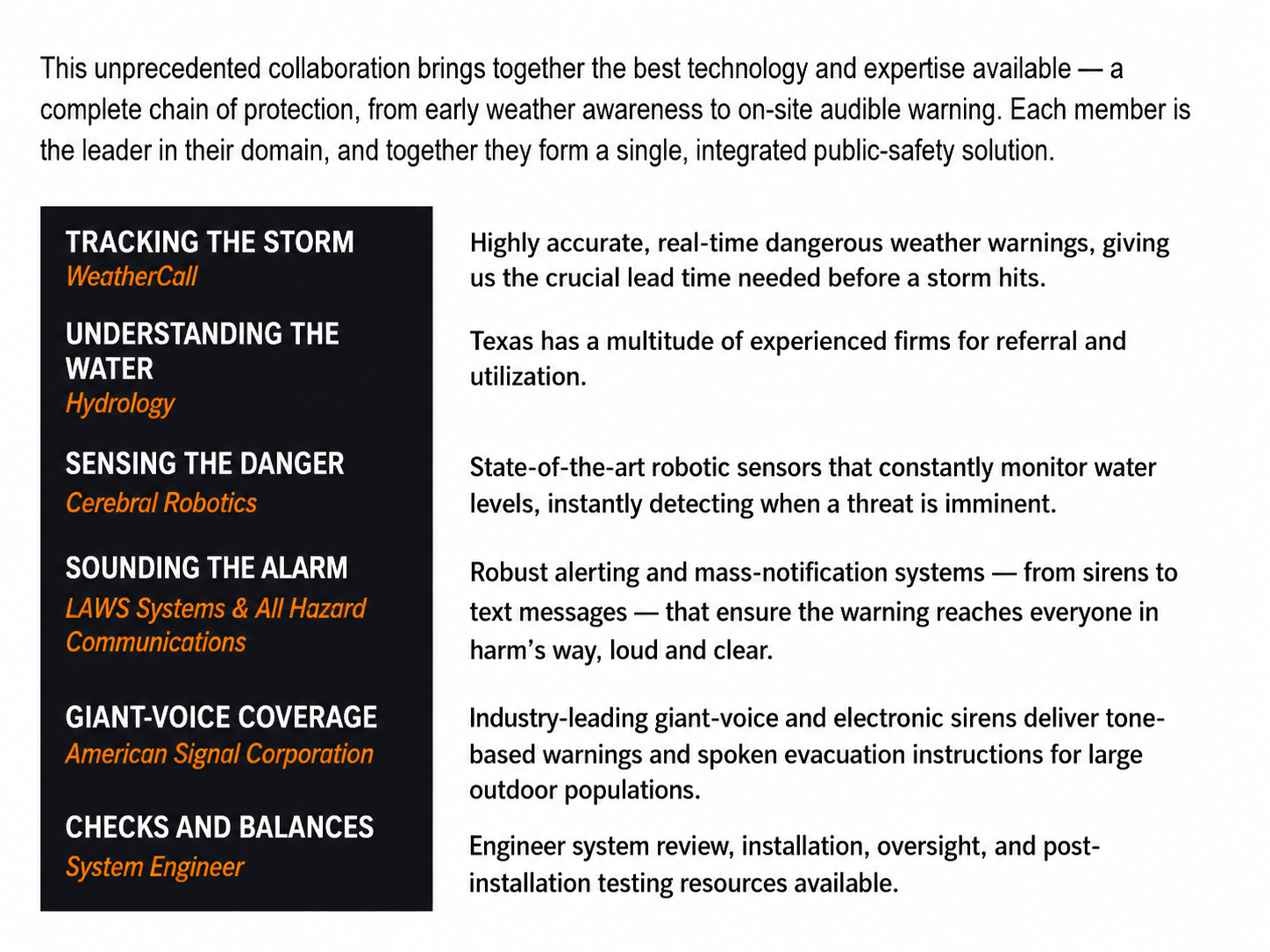
Total Alert Solutions Alliance unites five specialists, each the leader in their field, plus a referral network of hydrology and engineering partners — together, 220+ years of combined experience.
Premier location-specific, storm-specific severe-weather notification since 2007. 65M+ phone calls and 80M+ text messages delivered. Weather Ready Nation Ambassador and NWS Trusted Partner.
Wireless Watchman, Charlie Ball, and Magic Carpet — sensor-to-action warning, alerting, and intelligence technology.
NOAA/NWS-activated outdoor warning sirens, fixed and mobile, Texas-based, 20+ years of siren engineering experience.
Voice and tone mass-notification design, installation, and multi-manufacturer integration; clients in 27 states.
Giant-voice and electronic sirens, American-made in Milwaukee for 80+ years.
A referral network of hydrology firms for flood-risk modeling, independent engineering review for installation oversight and completion testing, and full weather stations and PTZ camera networks.
Why This Matters to You
Your guests trust that a property open to the public has already thought through the worst case. One coordinated, engineered system protects that trust — and satisfies whatever your state requires now or adds next, without stitching together multiple vendors under deadline pressure.
RV parks and campgrounds are exactly the kind of dense, transient, flood-adjacent population programs like Texas SB3 are built to protect — and they often sit just outside city limits, inside your jurisdiction. The Alliance’s sensor-to-siren chain extends coverage there without building a new system from scratch.
A commercial RV park or campground in your community draws visitors who assume someone has already planned for severe weather. Supporting access to a proven, engineered warning system protects both those guests and your community’s reputation — and is a defensible, documented decision if it’s ever questioned.
Texas Spotlight
Tight implementation deadlines, no clear procurement path? LAWS Systems, a Total Alert Solutions Alliance member, already holds the TXShare cooperative contract (RFP #2025-086) for wireless emergency alert systems and outdoor warning sirens through August 2030 — letting qualifying Texas operators move straight to implementation without a competitive RFP cycle.
Next Step
We review your sites, common areas, and crossings for coverage.
We map your state’s current and pending requirements to your specific property.
Transparent detail on exact equipment and services — no surprises.
Phased to your timeline and your budget, or coordinated through your county’s cooperative/RFP process where applicable.
This page summarizes publicly available legislative and regulatory information as of September 2026 and is provided for general informational purposes; it is not legal advice. RV park and campground operators should confirm current requirements with their state licensing agency or legal counsel. Total Alert Solutions Alliance tracks new and pending state weather-safety legislation on an ongoing quarterly basis.